SBRANDSTUDIO PLAYBOOK
Marketing frameworks for better brand decisions.
Is your brand actually different or just describing itself differently?
Open three competitor websites. Read their headlines. Their About sections. Their LinkedIn bios. Maybe even a few of their ads.The words change. The logos change. The colours change.But the conversation often sounds strangely familiar.
“Innovative solutions.”
“Customer-first approach.”
“Personalised experiences.”
“Future-ready technology.”
“Empowering businesses to grow.”
There is nothing technically wrong with any of these statements. The problem is that they could belong to almost anyone. That is where positioning becomes interesting.
Positioning is not simply deciding what your brand does. It is deciding what you want to be known for, by whom, and why that association should matter to them.
And if your customer could replace your brand name with a competitor’s without noticing, you may not have a copy problem.
You may have a positioning problem.
The sameness problem
When businesses ask, “What makes us different?”, they often start listing things they have. More features. A more personalised process. Better ingredients. More mentors. More integrations. More experience. But a difference is not automatically a position. The better question is:
What could we become known for that actually matters to a specific customer?
That small shift changes the exercise completely. You move from: What do we have? to: What do we want to be known for?
First, remove the logo Here is a simple test. Imagine three fictional AI companies with these positioning statements:
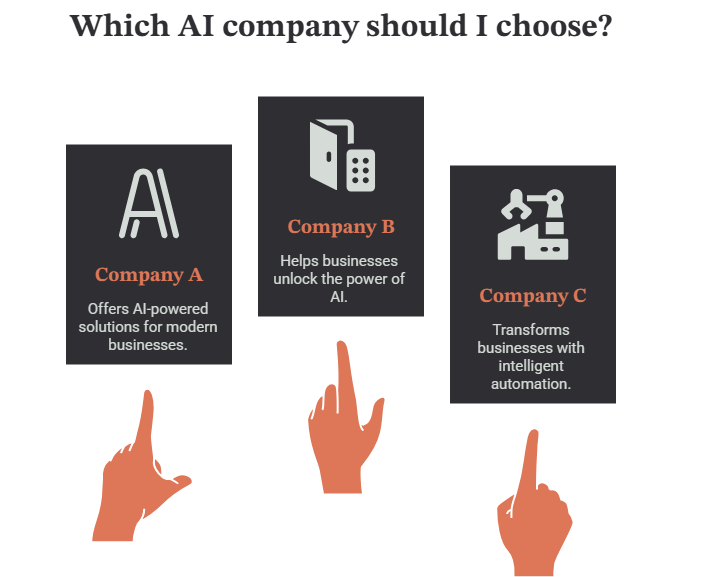
Now hide the logos. Can you tell which company is which? Probably not. And that’s the point. Different companies. Almost the same conversation.
A strong position should create some recognition before the logo appears. Not necessarily because nobody else could make the claim. But because you have built a stronger association around that idea. That’s what we’re testing.
The Positioning Stress Test
Think of this as pressure-testing your positioning before you spend months building campaigns around it. There are six questions.
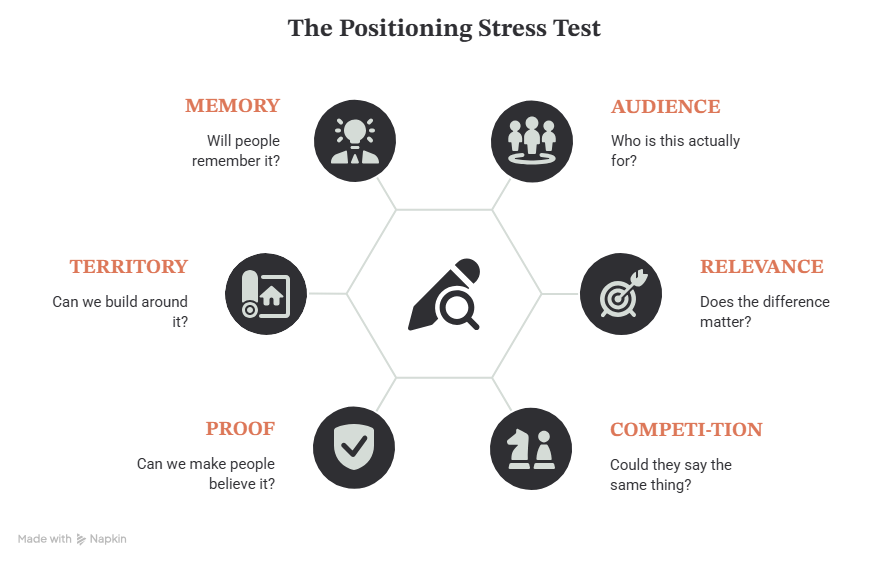
01. Audience: Who is this actually for?
“Everyone who wants to grow their business.” “Modern consumers.” “Businesses looking for innovative solutions.”
These aren’t really audiences. They’re attempts to avoid excluding anyone. But strong positioning creates a boundary.
It should make one person think: “This is for me.” And someone else think: “This probably isn’t for me.”
| Compare | |
| Weak | Stronger |
| “Helping teams get more done.” | “Helping small creative teams manage the chaos of client feedback, approvals and revisions.” |
The second statement gives you somewhere to start. You know who you’re talking to. You know what problem they’re experiencing. And you have a much clearer idea of what your brand could talk about.
Try completing: We are specifically for ______ who struggle with ______.
If you can’t fill this in without using words like everyone, modern, ambitious, growing or businesses, go back to the audience.
02. Relevance: Okay. And?
Being different isn’t enough. Your difference has to connect to something the customer actually cares about. Imagine a company saying:
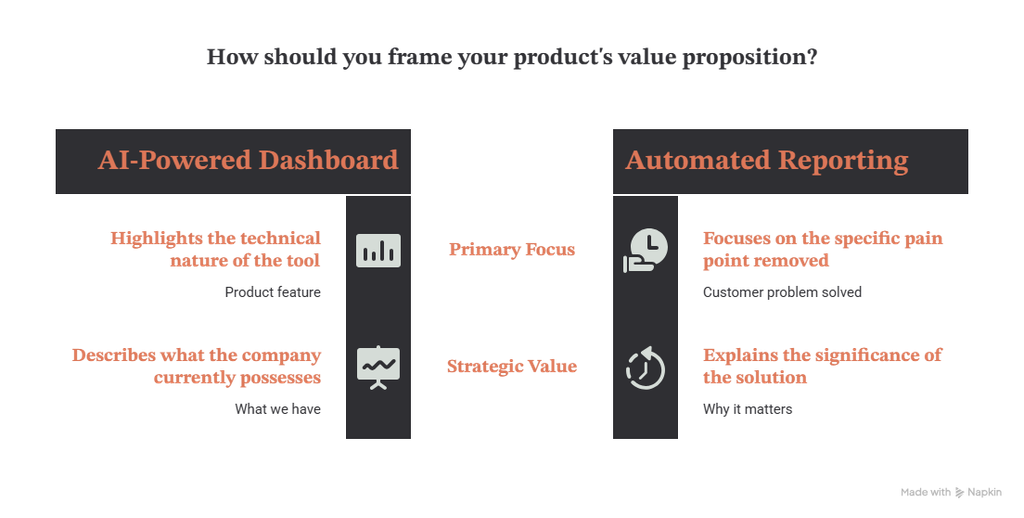
“We use AI to automate your reporting.” Okay.
And? Now imagine:
“We help marketing teams stop spending Monday mornings turning last week’s campaign data into spreadsheets.”
Same underlying capability. Very different customer relevance. The second statement connects the product to a frustration people already recognise. That’s the question to ask:
Would my customer care if this disappeared tomorrow?
If the answer is no, you may have a feature. You may have a capability. You may even have something genuinely impressive. But you may not yet have a meaningful position.
A difference only becomes positioning when someone has a reason to care about it.
03. Competition: Could they say exactly the same thing?
Here’s one of the easiest tests. Take your positioning statement. Now imagine your biggest competitor putting their logo on it. Does it still work? For example:
“We create data-driven strategies that help ambitious businesses grow.”
Now replace your logo with another agency’s logo. Still works. That’s category language. Your competitor doesn’t necessarily need to be incapable of doing what you do. The real question is:
Could they make the same claim without changing anything?
If yes, your positioning probably isn’t doing enough work.
04. Proof: Can you make people believe it?
Positioning sounds strategic in a presentation. Then it meets reality. A brand might claim:
“The fastest.” “The most trusted.” “Built for creators.” “Designed for simplicity.”
Fine. Now prove it. If you say you’re built for creators, does the product actually behave like it? If you say you’re simple, is onboarding simple? If you say you’re trusted, where does that trust show up?
Positioning should be visible across the brand:
Product → Experience → Content → Campaigns → Customer proof
Otherwise, you’re not building an association. You’re writing a sentence in a strategy deck.
05. Territory: Can you build around it?
A useful position gives the brand somewhere to go. Take the idea of simplicity. You could build content around:
- over-engineered products
- confusing pricing
- decision fatigue
- complicated onboarding
- unnecessary features
- information overload
- doing more with less
Suddenly, the positioning starts generating ideas. That’s territory.
Ask: If we committed to this idea for the next two years, would we run out of things to say? If the answer is yes, you may have a campaign concept. You may have a tagline. But you might not have a positioning territory.
06. Memory: Will people remember it?
Your customer sees hundreds of brands. They don’t have a spreadsheet in their head comparing your value propositions. They remember associations. So ask:
If someone encountered our brand today, what is the one thing we want them to remember tomorrow?
Compare:
“Flexible, affordable and innovative solutions for modern businesses.”
with:
“The bank built for freelancers.”
The second gives the brain a shortcut.
You may agree or disagree with the positioning itself. The important difference is that it creates a much clearer association.
And that is what positioning is supposed to do.
Let’s stress-test a fictional brand
Meet FlowAI. It’s an imaginary AI productivity company. Its current positioning:
“An intelligent AI-powered productivity platform helping modern teams work smarter and achieve more.”
Sounds polished. Sounds credible. Sounds like something you might see on a homepage. It also sounds like dozens of other AI productivity products.
Let’s put it through the test.
| Test | What happens? |
| Audience | “Modern teams” is too broad. |
| Relevance | “AI-powered productivity” is generic. |
| Competition | Almost any productivity platform could say this. |
| Proof | Possible- but the brand would need evidence. |
| Territory | “Work smarter” gives the brand little distinctive territory. |
| Memory | What exactly should someone remember? |
Nothing here tells us FlowAI is a bad product. That’s not the problem. The problem is that the product may be more specific than the story being told about it.
So let’s change where we start. Suppose customer research reveals that small creative agencies are constantly losing time chasing:
feedback → approvals → revisions → scattered messages
across email, WhatsApp and project management tools. Now we have something more interesting.
Instead of: “An intelligent AI-powered productivity platform helping modern teams work smarter and achieve more.”
We could explore: “Helping creative teams turn chaotic client feedback into one clear workflow.”
It’s not a final brand strategy. It’s a much better starting point. Why? Because suddenly we have:
A clearer audience
Creative teams. A clearer problem
Chaotic client feedback. A clearer territory
The mess created by feedback, approvals and revisions. A clearer product story
One workflow that brings that chaos together.
And now the brand has things to talk about.
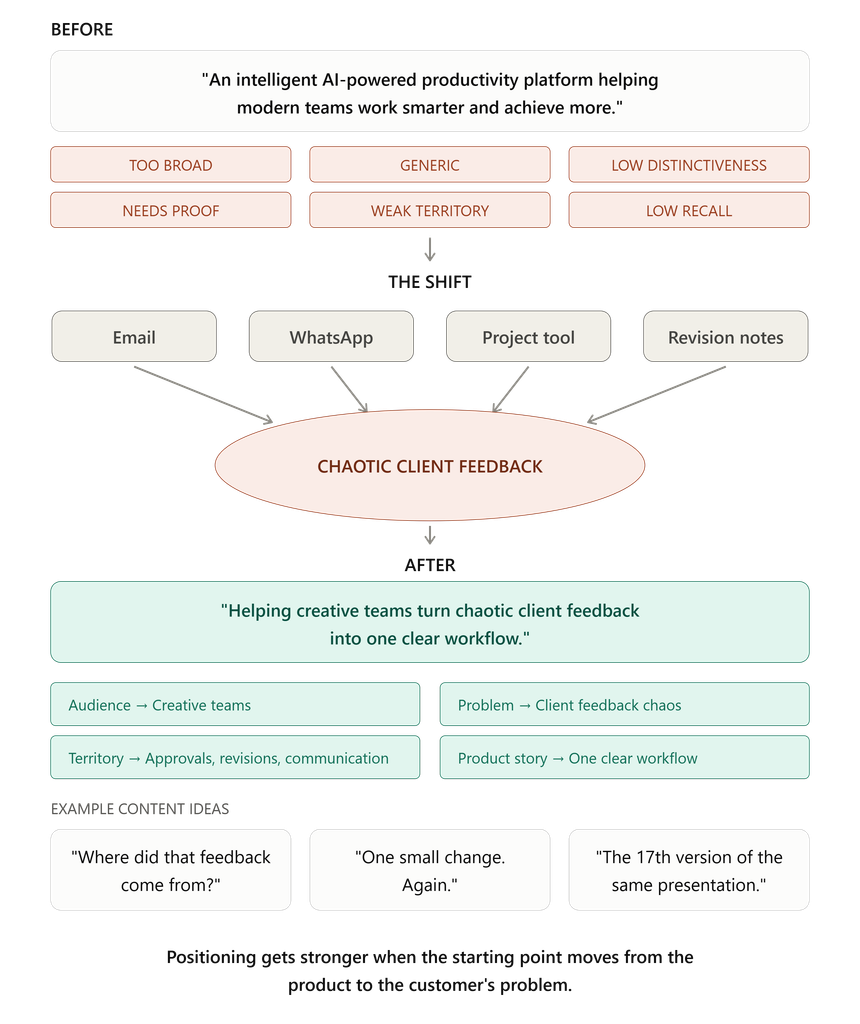
And notice what just happened. The positioning didn’t merely make the brand sound different. It gave the brand something to say. That’s one of the most useful ways to think about positioning.
A strong position can influence:
What you talk about.
What you create.
What you emphasise.
What you refuse to emphasise.
What your product experience needs to prove.
Your Positioning Probably Isn’t Positioning
If your positioning only works on a PowerPoint slide, you don’t have positioning. You have a sentence.
Before approving it, ask:
Audience: Who is it for?
Relevance: Why should they care?
Competition: Could anyone else say it?
Proof: What makes it believable?
Territory: Can we build around it?
Memory: What should people remember?
You don’t need six perfect answers.You need to know where the positioning breaks.
Positioning isn’t what you write. It’s what people remember.
The product proves it.
Content reinforces it.
Campaigns dramatise it.
Experience confirms it.
If none of these do the work, you’re not building a position. You’re decorating a PowerPoint slide.
Steal This: Positioning Canvas
Use this before you write your next positioning statement.
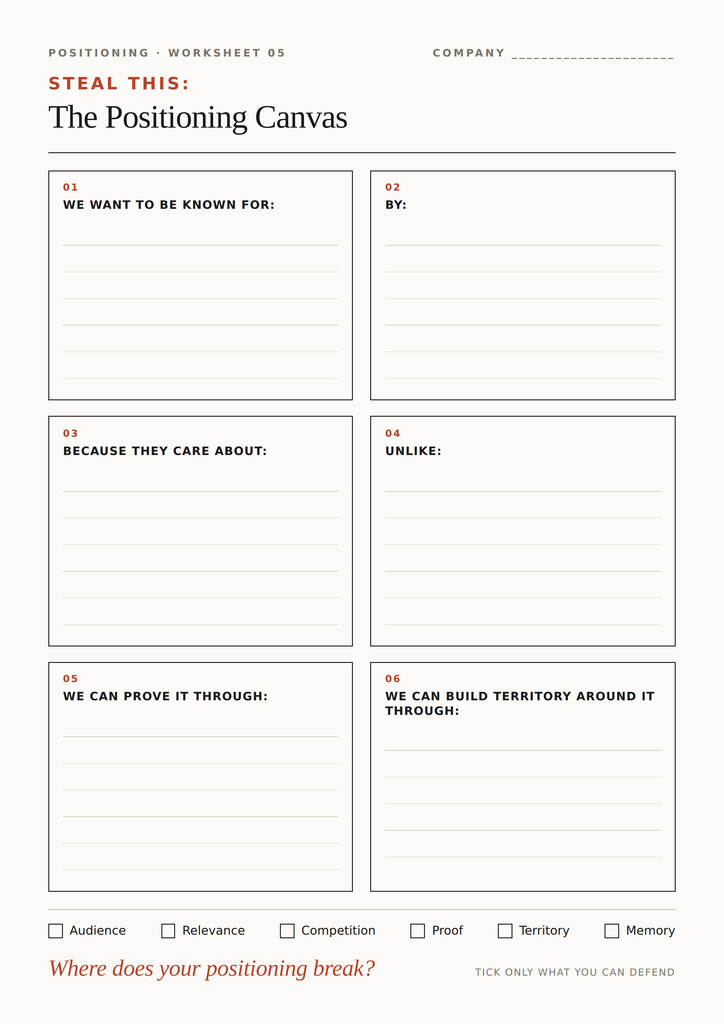
The point of a stress test isn’t to prove that your strategy is right. It’s to find out where it breaks before the market does.
Want more frameworks like this?
Explore more marketing playbooks, case studies and strategic breakdowns at SBrandStudio.